

Central Asia Is the Next Emerging Frontier: The GETVISION ASIA Thesis

Central Asia is the next emerging frontier because three of its economies are building different parts of the same investable system at the same time. Kazakhstan is building the institutions that let international capital in. Uzbekistan brings population and consumer scale. Kyrgyzstan offers a small, fast-growing market where one committed investor can shape the deal flow. GETVISION ASIA is built around that division of labor.
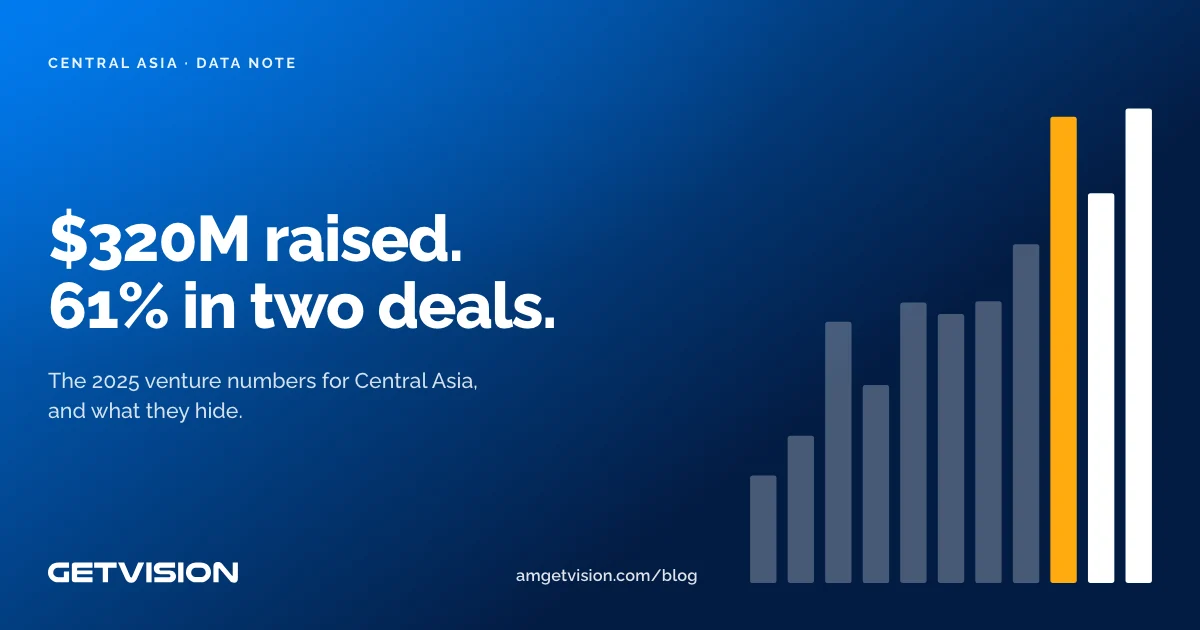
The numbers are early but real. Central Asian startups raised a record $320 million in 2025, according to RISE Research's 2026 regional report. Two deals, Higgsfield and Uzum, made up 61% of that total. Without them the market was $124.5 million, still 31% above 2024. That is the honest picture: a market that is growing, concentrated, and short of the layers that turn startups into exits.
This piece sets out the thesis we work from: why now, the job each country does, what is still missing, and how we operate on the ground. Each country has its own deep dive, starting with Kazakhstan as the institutional gateway.
Key takeaways
- Central Asia is not one market but three complementary markets with different jobs: institutions, scale and access.
- Venture funding hit a record $320 million in 2025, but two deals made up 61% of it, so the total overstates depth.
- Kazakhstan is the institutional gateway, with a common-law financial center and a fund of funds targeting $1 billion.
- The binding constraints are Series A capital, exits and structuring, not founder talent or macro growth.
- GETVISION ASIA works in three stages: consult, raise, co-build, with VC deals run through RaiseTalks and PE through GETVISION Group.
Why Central Asia, and why now
Frontier markets usually ask investors to wait for institutions. Central Asia is different in one respect: the institutions are arriving before the capital.
Three signals stand out.
- Growth is fast. Uzbekistan's economy grew 7.7% in 2025 according to its statistics committee, Kazakhstan's grew 6.5% according to its Economy Ministry, and the Kyrgyz government reported 11.1%.
- The plumbing exists. The Astana International Financial Centre runs an English-language court on the principles of English law. Uzbekistan's IT Park had more than 3,400 member companies at the end of 2025. Kyrgyzstan made its High Technology Park tax regime open-ended in November 2024.
- Capital is organizing. Kazakhstan's Alem Ventures Fund, a fund of funds with a $1 billion target, reported a $115 million first close in November 2025, per the country's digital development ministry.
It is not a story about one hot sector. It is a story about the basic infrastructure of private capital (courts, tax regimes, fund-of-funds programs, tech parks) being built in parallel across three countries.
The opportunity sits in the gap between that infrastructure and the capital that uses it. RISE Research estimates the region would need an extra $0.5 billion to $1.1 billion of venture capital a year to match the share of GDP seen in Brazil or the EU. Investors who arrive while that gap is wide get first access to the best companies.
The three-country thesis
We do not treat Central Asia as an index. Each country has a specific job in how we source, structure and fund deals.
Kazakhstan: the institutional gateway
Kazakhstan is where LP capital lands first. The AIFC offers common-law contracts, an English-language court and arbitration center, and tax exemptions for qualifying activities until 2066. The Alem Ventures Fund and state investors such as Qazaqstan Investment Corporation give foreign fund managers a local anchor LP.
Kazakhstan is also the deepest venture market in the region. RISE Research counts $209 million raised in 2025, or $79 million without Higgsfield's $130 million Series A.
Uzbekistan: the scale market
Uzbekistan had 38.2 million people on January 1, 2026, per its National Statistics Committee, the largest population in the region. Uzum, its e-commerce and fintech group, raised $65.5 million at a $1.5 billion valuation in 2025, as reported by The Times of Central Asia.
Development finance is deep too. IFC called Uzbekistan its largest portfolio in Central Asia when it reported a record $1.568 billion invested and mobilized there in fiscal 2023. Scale helps, and it can also mislead, which we unpack in our Uzbekistan market map.
Kyrgyzstan: the deliberate homebase
Kyrgyzstan is the smallest of the three, and it is where we chose to start. Startups there raised about $3 million in 2025, according to RISE Research's figures.
That is the point, not the problem. When a whole market raises a few million dollars a year, one active and disciplined investor visibly changes the number of deals that get done. We explain the logic in the case for starting with the smallest market.
The three countries side by side
| Indicator | Kazakhstan | Uzbekistan | Kyrgyzstan |
|---|---|---|---|
| Role in the thesis | Institutional gateway | Scale market | Homebase |
| Active VC funds / AUM | 12 funds / $157M | 15 funds / $180M+ | Emerging, HTP-led |
| VC deployed 2025 | $209M ($79M ex-Higgsfield) | $99M ($34M ex-Uzum) | $3M |
| Startup ecosystem value | $2.16B | $3.9B | $293M |
| Real GDP growth 2026 | 4.5-4.6% | 6.4-6.8% | 6.1-8.9% |
| Investment inflow 2025 | $20.5B gross FDI | $43.1B incl. IFI loans | $1.31B FDI |
The table uses GETVISION ASIA's market data, updated where newer public sources differ. Venture totals come from RISE Research's 2026 report, and Kazakhstan's fund count and AUM are RISE's 2024 figures. Uzbekistan's $43.1 billion is the Ministry of Investment, Industry and Trade's total, which includes $38.2 billion of FDI and $4.9 billion from international financial institutions. Kyrgyzstan's FDI is the National Statistical Committee figure reported by The Times of Central Asia.
What is still missing
Growth and institutions are necessary. They are not sufficient. Five gaps decide whether capital that enters the region can also leave it with a return. The full numbers are in our data note on venture capital in Central Asia.
Local VC depth. RISE Research puts total regional venture AUM at about $1 billion and estimates it needs to reach $3.6 billion for sustainable growth. Most local funds write pre-seed and seed checks.
The Series A layer. Investors interviewed by RISE describe a shortage of funds able to write the $5-10 million checks companies need to scale. Founders who win at seed often hit a wall at A, or relocate to raise it.
Pipeline density. RISE counts about 2,000 startups at MVP stage but only 370 unique funded startups over three years, or 4.6 funded startups per million people. The conversion rate is high. The base is small.
Exits. Without many local strategic buyers or deep public markets, the realistic routes are sales to regional or global strategics and secondary sales into later foreign rounds. An investor who cannot name a buyer type at entry is guessing.
Structuring. Many companies are still local entities with informal cap tables, undocumented founder arrangements and revenue in local currency. Global investors want a clean holding structure, a recognized governing law and a credible currency story.
Capital is arriving faster than the structures that let it leave.
How GETVISION ASIA works
GETVISION ASIA is GETVISION's operating arm in the region. Our short description is "we structure strategy into capital." In practice, we work in three stages, and most mandates move through all three.
- Consult. Investment readiness, economic reasoning, legal investment structuring, data rooms, investor materials, fundraising strategy and full-cycle investor relations. This is where a local company becomes legible to a foreign investor.
- Raise. Selected capital-raise mandates. Venture deals run through RaiseTalks, which gives founders an investor-grade data room and a readiness score and gives investors a weekly shortlist of matched, pre-scored founders. PE and growth deals run through GETVISION Group, with co-investment logic and access to global capital networks.
- Co-build. Selective co-investment in tourism, transport, real estate, agro and essential regional infrastructure, focused on long-cycle value creation rather than short-term speculation.
The order matters. Raising before structuring wastes investor attention. Co-investing before a company has institutional reporting puts capital behind the very gaps we are paid to close.
Our primary focus is Kyrgyzstan, with a broader lens across Kazakhstan, Uzbekistan, Tajikistan and the regional growth corridors. The sectors we cover range from infrastructure, energy, water and logistics to technology, financial services and selected private equity. More on the model is on the GETVISION ASIA page.
The risks we price in
A thesis that ignores risk is a brochure. These are the risks we underwrite on every mandate in the region.
- Currency. Revenue in tenge, som or sum and investors who count in dollars. We look for dollar-linked revenue, export income or pricing power, and we model downside cases in local currency.
- Concentration. One or two deals can make a country's year. We judge markets by deal counts and medians, not headline totals.
- Governance. Founder-run companies often lack boards, audited accounts and documented related-party dealings. We fix this before a raise, not during diligence.
- Geopolitics and compliance. Trade and payment flows through the region draw scrutiny from Western regulators. Sanctions screening of counterparties and investors is part of standard diligence.
- Exit. We define the likely buyer type and the holding structure before we commit capital or a mandate.
Frequently Asked Questions
For long-horizon investors, yes, with conditions. Growth is strong, institutions such as the AIFC and the regional tech parks are in place, and venture funding reached a record $320 million in 2025 according to RISE Research. The conditions are clean structuring, credible local partners and a realistic exit plan.
It depends on the job you need done. Kazakhstan has the deepest venture market and the strongest legal infrastructure, Uzbekistan has the largest population and consumer base, and Kyrgyzstan offers the least competition for early deals.
RISE Research reports a record $320 million in 2025 across the region. Excluding the Higgsfield and Uzum rounds, the total was $124.5 million, up 31% from 2024.
GETVISION ASIA is GETVISION's Central Asian investment house. It consults companies on readiness and structuring, runs selected fundraising mandates (VC through RaiseTalks, PE and growth through GETVISION Group) and selectively co-invests in regional infrastructure such as tourism, transport, real estate and agro.
The main risks are currency volatility, a thin Series A and exit market, governance gaps in founder-run companies, and sanctions-compliance exposure. Each can be priced and partly mitigated through structure, co-investors and diligence, but none should be ignored.
Read next
 Why Kyrgyzstan: The Case for Starting With the Smallest Market
 Kazakhstan: The Institutional Gateway for LP Capital in Central Asia
 Uzbekistan: Investing in Central Asia's Largest-Scale Market
 Venture Capital in Central Asia 2026: Funds, Deal Flow and the Gaps
GETVISION ASIA advises, raises and co-invests across Kazakhstan, Uzbekistan and Kyrgyzstan: readiness, structuring, investor materials and capital-raise mandates, with local execution and global capital standards. Start a conversation with GETVISION ASIA.