Central Asia Is the Next Emerging Frontier: The GETVISION ASIA Thesis
9 min read
Why Kazakhstan, Uzbekistan and Kyrgyzstan form one investable region, what is still missing, and how GETVISION ASIA consults, raises and co-builds.

Expert insights on emerging markets, Central Asia, investment readiness and growth capital.
9 min read
Why Kazakhstan, Uzbekistan and Kyrgyzstan form one investable region, what is still missing, and how GETVISION ASIA consults, raises and co-builds.
9 min read
How the AIFC, Astana Hub and Kazakhstan's fund-of-funds programs channel LP capital into Central Asia, and what foreign GPs and founders should check.
8 min read
Uzbekistan offers 38 million people, fast growth and a reformed IT regime. Where its scale helps investors, where it misleads, and what to check first.
8 min read
Why GETVISION ASIA chose Kyrgyzstan as its homebase: a permanent tech-park regime, little competition for deals, DFI support, and the risks we underwrite.
8 min read
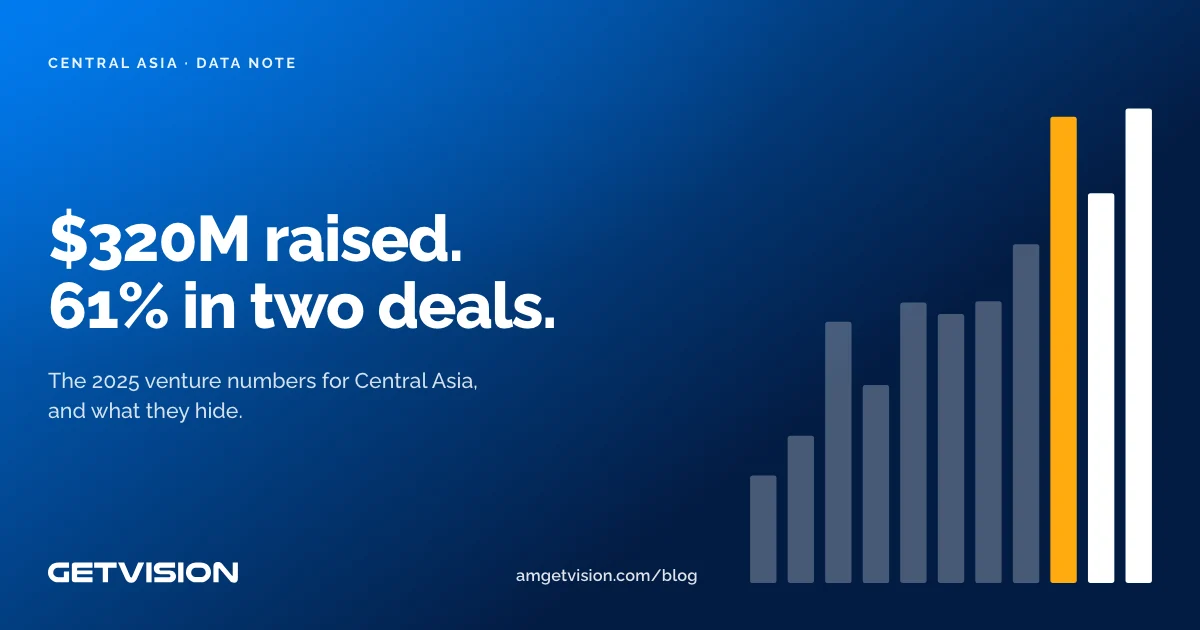
Central Asian startups raised a record $320M in 2025. Funds, deal flow, stage mix and the missing Series A layer, country by country.
9 min read
A practical guide to holdcos, shareholder agreements, governing law, arbitration and repatriation for deals in Kazakhstan, Uzbekistan and Kyrgyzstan.
8 min read
Why logistics is Central Asia's infrastructure opportunity: Middle Corridor volumes, the projects that matter, where private capital fits and the risks.
8 min read
What makes Kyrgyz mountain, lake and eco-tourism investable: operators, seasonality, access and land rights, plus a checklist for underwriting hotels.
8 min read
Where capital earns the most in Central Asian agribusiness, from aggregation and cold chain to processing and certification, in a five-stage framework.
8 min read
What foreign investors need from Central Asian founders: a familiar structure, an English data room, governance, a currency story and trust built remotely.
8 min read
In a forming market, the founder is the one asset that survives every pivot. What we look for, how it changes terms, and what it does not mean.
8 min read
Sector-agnostic does not mean thesis-free. The five filters that replace a sector bet, a scoring grid, diversification logic and the common traps.
8 min read
The model is rented and getting cheaper. In emerging markets, a durable AI advantage comes from local data, language, workflows and distribution.
7 min read
How early-stage investors price currency, country, exit and key-person risk in frontier markets, and what founders can do to lower each one.
7 min read
Thin IPO markets and few buyers make the exit the hardest part of emerging-market investing. Who actually buys, and how to design for it from seed.
9 min read
How to design impact into the business model, measure it with the five dimensions and IRIS+, and report it to investors without greenwashing.
7 min read
A 90-day plan after closing, a monthly operating cadence, and a clear menu of where investors help and where they should stay out of the way.
8 min read
The red flags investors find in emerging-market diligence, from unclear ownership to related-party revenue, and how founders fix each before they raise.
9 min read
What investment readiness means, how investors score Team, Product, Market and Deal, a self-assessment, and a staged 12-week plan to get ready to raise.
8 min read
Build a driver-based startup financial model: unit economics first, sourced assumptions, real scenarios, and numbers that match the deck to the dollar.
9 min read
How SAFEs, convertible notes and priced rounds work, when each fits, what changes outside the US, and how to avoid stacking dilution before Series A.
9 min read
What an emerging-market data room needs beyond the standard list: corporate history, licenses, currency, related parties, translations and holdco files.
8 min read
Why US startup comps mislead emerging-market founders, how to adjust for country risk and liquidity, and which early-stage valuation methods hold up.
8 min read
The slide order, what each slide must prove, the three-minute skim test, what to cut, and the extra slides emerging-market founders need.
8 min read
The cap table mistakes that stall diligence, from dead equity to nominee holdings, how investors read a cap table, and the order to clean it up.
9 min read
The real fundraising timeline phase by phase, why emerging-market raises run longer, and the runway rule that keeps founders out of panic mode.
9 min read
Investor relations is a system, not a fundraising sprint. The seven stages, owners, artifacts and cadence from first contact to the next round.
8 min read
A fill-in monthly investor update template with headline numbers, wins, misses, asks and runway, plus tiered reporting and how to write a bad month.
8 min read
How to build an investor long list, qualify it by stage, sector, ticket and region, tier it, move it through pipeline stages and keep the CRM honest.
7 min read
What private companies should disclose to investors and when: materiality, consistency, bad news, data access, confidentiality and information rights.
8 min read
The nine question blocks investors cover in a first meeting, sample questions for each, how to build a Q&A document and what to ask investors back.
7 min read
After Series B, the work shifts from finding fit to allocating capital. Five strategic questions, a decision table and signs you need outside advice.
9 min read
A complete guide to planning a company sale: exit routes, buyer mapping, 24 months of readiness work, the process stages and what moves value.
8 min read
The six areas buyers diligence first in an acquisition, the red flags in each, and how vendor due diligence lets sellers find problems before buyers do.
8 min read
How scale-ups should build a board: composition, independent directors, committees, the board pack, decision rights and an annual board calendar.
9 min read
Score markets on attractiveness and ability to win, pick the right entry mode, and sequence expansion so one failed market cannot sink the company.
8 min read
Founder secondaries, early investor sales, tender offers and continuation vehicles compared: how each is priced, what it signals and when it fits.
8 min read
When a merger creates more value than another round: consolidation in fragmented markets, realistic synergies, integration, governance and financing.
8 min read
What a value creation plan contains, the five levers growth investors pull, a 100-day plan with owners and KPIs, and what founders should negotiate.
9 min read
A complete guide to accelerators funded by development institutions and NGOs: objectives, selection, curriculum, mentors, investor days and reporting.
9 min read
What investment readiness programs for women founders can fix, what they cannot, and the design lessons from our UAE program with EWA Accelerator.
8 min read
A framework for measuring accelerator impact: input, output and outcome metrics, follow-on funding, survival, jobs, attribution and DFI reporting.
9 min read
How development finance institutions such as IFC, EBRD and ADB invest, what they require from founders and funds, and how long the process takes.
8 min read
How to turn accelerator graduates into closed rounds: picking the top founders, finding a lead, SPV mechanics, investor day design and follow-up support.
9 min read
Why real estate with social impact works best as a partnership: partner roles, JV waterfalls and governance, impact by design, and shared risk.
9 min read
Infrastructure equity owns the cash flows of essential services. How brownfield, greenfield, PPPs and DFI co-financing fit Central Asia's build-out.
8 min read
How to underwrite schools, clinics, workforce housing and mixed-use projects so that social value supports returns instead of eroding them.
9 min read
A guide for tech founders: how multi-family offices differ from single-family offices, what they do, and when to engage one around a liquidity event.
8 min read
Why family offices co-invest, where deals come from, which terms to negotiate, and a diligence checklist that guards against adverse selection.
8 min read
How equity, venture debt, bank loans, revenue-based financing and bonds compare on cost, dilution and covenants, and which capital fits each stage.